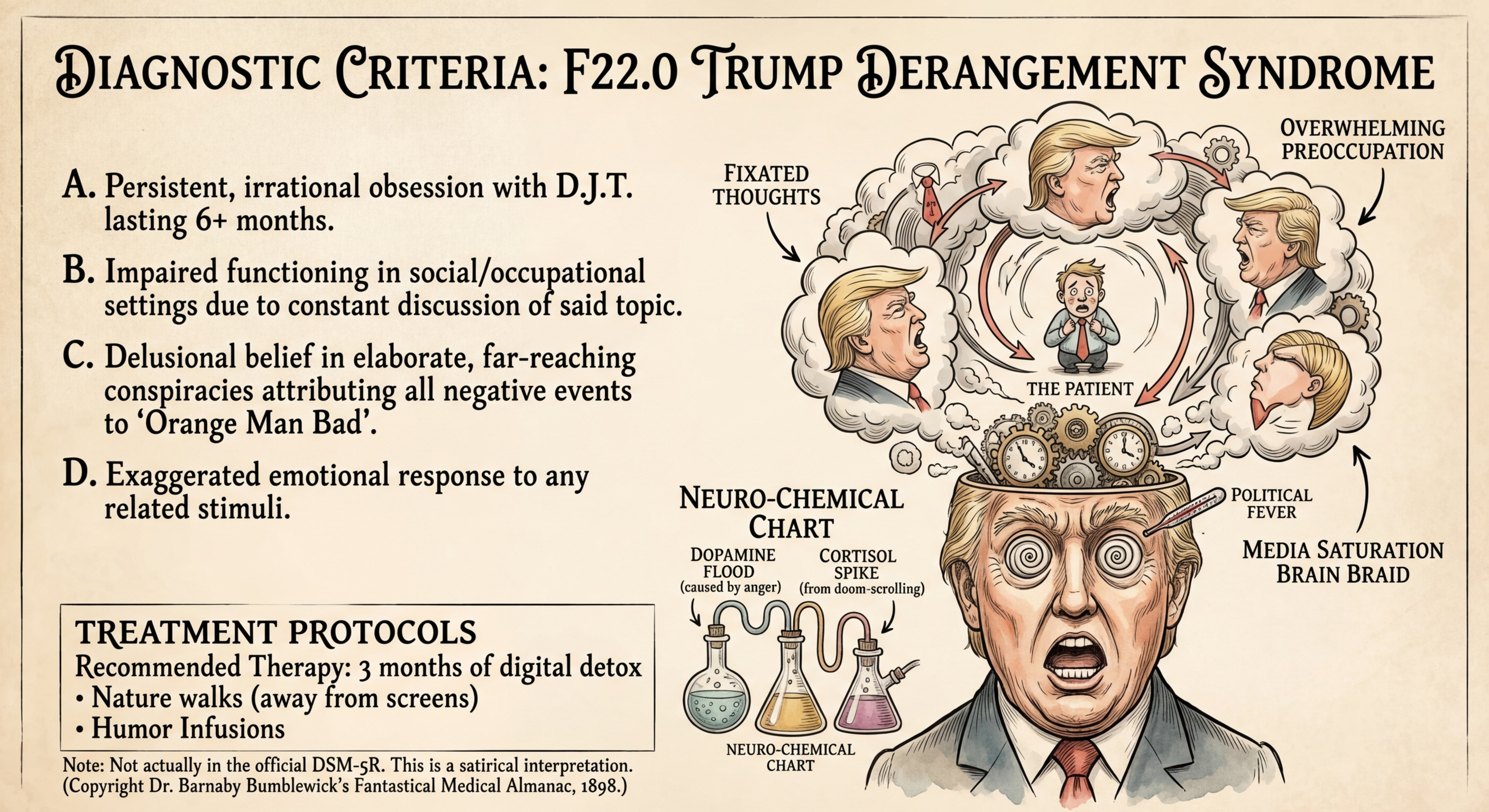
1. Diagnostic Criteria
A. Presence of one (or more) delusions with a duration of 1 month or longer.
- Specific to TDS: The delusional belief that the 45th/47th President of the United States is concurrently the sole architect of modern societal collapse, a sentient force of nature, and an imminent existential threat to the individual’s daily, personal reality, regardless of contradictory evidence.
B. Criterion A for Schizophrenia has never been met. (Hallucinations, if present, are not prominent and are generally limited to hearing the subject’s voice in innocuous daily noises, such as leaf blowers or coffee makers).
C. Apart from the impact of the delusion(s), functioning is not markedly impaired, and behavior is not obviously bizarre or odd.
- Note: The individual may maintain professional, social, and familial obligations, though conversations inevitably pivot to the subject, leading to episodic acute social rejection.
D. If manic or depressive episodes have occurred, these have been brief relative to the duration of the delusional periods.
E. The disturbance is not attributable to the physiological effects of a substance or another medical condition.
2. Clinical Description and Features
- Affect: Frequently displays “inappropriate affect” when mentioning the subject, characterized by abrupt transitions from calmness to intense rage, weeping, or frantic hyperventilation.
- Cognition: Shows high-functioning cognition in all areas except those pertaining to the political entity. Features strong “confabulation” (creating narratives to fill gaps in logical reasoning).
-
Behavioral Symptomatology:
- Obsessive Rumination: Uncontrollable, repetitive consumption of news feeds dedicated to the subject.
- Externalization of Blame: Attributing all personal misfortunes (e.g., lost keys, slow traffic, rainy weather) to the subject’s policies or rhetoric.
- Catastrophizing Syndrome: The firm belief that the current day is always “the end of democracy,” repeated daily without exhaustion.
- Social Functioning: Leads to severe polarization within interpersonal relationships, frequently necessitating the blocking of relatives on social media platforms (digital isolation).
3. Specifiers
- With Hyper-reactive Affect: Subject experiences tremors, nausea, or tachycardia when viewing televised appearances of the subject.
- With Cognitive Rigidity: Inability to recognize logical contradictions in arguments against the subject (e.g., believing the subject is simultaneously incompetent and an omnipotent political mastermind).
4. Differential Diagnosis
- Major Depressive Disorder with Psychotic Features (F32.3): Distinguished by the absence of localized, specific content in the delusions.
- Generalized Anxiety Disorder (F41.1): TDS is characterized by a focal point (the subject), whereas GAD is generalized.
5. Prognosis
The disorder appears to be highly resistant to cognitive-behavioral therapy (CBT) and conventional pharmacological interventions, often requiring long-term treatment involving total removal from social media, increased exposure to real-world interactions, and possible political boredom.